Are mortgage calculators accurate? Why your borrowing figure could be very different
Tags: Remortgages, Residential mortgages
Quick Summary
Mortgage calculators can be a useful starting point when working out how much you may be able to borrow, but the results should only be treated as a guide. Different banks and building societies use different affordability rules, meaning two lenders can produce very different maximum mortgage amounts for the same applicant.
Lenders may assess basic salary, bonuses, commission, overtime, self-employed income, debts, childcare costs, dependants and credit commitments in different ways. Some also offer higher income multiples to eligible first-time buyers, professionals and higher earners.
For example, borrowing at four times a £60,000 salary would provide a £240,000 mortgage, while six times income could increase this to £360,000, subject to affordability and lender criteria.
Trinity Financial’s mortgage brokers can compare affordability across a wide range of lenders and assess how much you could realistically borrow before you make an offer on a property.

Are mortgage calculators accurate? Why your borrowing figure could be very different
Mortgage calculators are a useful way to get a quick idea of how much you may be able to borrow or what your monthly repayments could cost. Each lender has its own mortgage affordability calculator, using different figures to determine the maximum loan size. But borrowers should not treat the figure on the screen as the amount a bank or building society will definitely lend.
The problem is that banks and building societies have very different affordability rules. Two borrowers earning the same salary could be offered very different loan amounts depending on their deposit, debts, regular expenditure, income structure, and the lender they approach. If they do not input a regular credit commitment, or enter a debt that is due to finish soon, the mortgage loan size will probably change once an application is submitted.
Some banks and building societies may be willing to offer four times salary, and others offer six times salary. This means the difference between the highest and lowest borrowing figures can be significant. Ultimately, some incomes are too complex to use a mortgage calculator and generate a figure that resembles the maximum possible loan size.
What does a mortgage calculator actually tell you?
There are broadly two different types of mortgage calculators.
- A mortgage repayment calculator works out approximately how much a mortgage will cost each month based on the loan size, mortgage term and interest rate.
- A mortgage affordability or maximum borrowing calculator estimates how much you may be able to borrow, usually based on your income and sometimes your financial commitments.
Repayment calculators can be particularly useful when comparing different rates and mortgage terms. Trinity Financial has its own mortgage calculator allowing borrowers to compare estimated capital-repayment and interest-only costs. Affordability calculations are more complicated because lenders want to understand your overall income, assets and financial commitments.
Why can mortgage affordability calculators give different answers?
Banks and building societies do not all calculate affordability in the same way. While a simple online calculator might multiply your salary by four, five or six times, a lender's full affordability assessment can take significantly more information into account.
This can include:
- Basic salary
- Bonuses and commission
- Bonus bigger than basic salary
- Overtime
- Self-employed profits or salary and dividends
- Contractor income
- Existing loans and credit cards
- Car finance
- Childcare and private school fees
- Pension contributions
- An upcoming pay rise
- Debts due to end soon
- Payments from The Bank of Mum and Dad
- Dependants
- Mortgage term and applicant age
- Deposit and loan-to-value
- Credit history
- Other properties and mortgages
Lenders can also have very different rules about which types of income they accept and how much of that income they will use.
One lender might use 100% of a regular annual bonus, for example, while another may take an average or use a smaller percentage. Self-employed applicants can also find that different lenders reach very different figures depending on whether they assess salary and dividends, net profit or an alternative measure of income.
Could a mortgage calculator underestimate how much you can borrow?
Yes. Borrowers often assume the danger with mortgage calculators is that they will show an unrealistically high figure. But they can also significantly underestimate borrowing capacity.
There are lenders prepared to offer higher income multiples to certain borrowers, including some first-time buyers, professionals and higher earners.
Trinity Financial's maximum borrowing calculator illustrates how lending multiples can range from around 4.5 times income to 5, 5.5 or even 6 and 6.5 times income in suitable circumstances, subject to the individual lender's affordability and eligibility criteria.
This means someone could put their income into a basic calculator, conclude they cannot afford the property they want and stop searching – even though another lender might potentially provide the required mortgage.
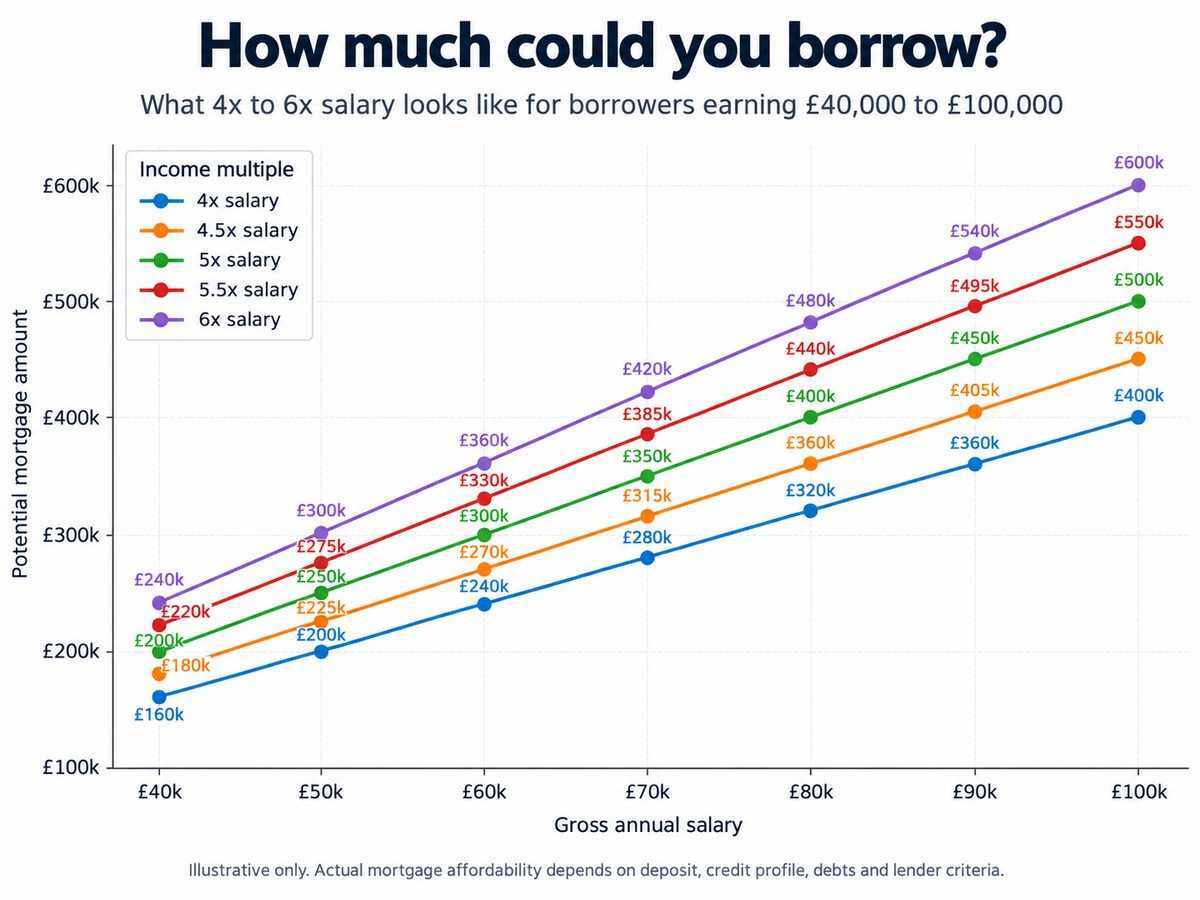
How much could you borrow? Our mortgage income multiple chart shows the difference between borrowing 4x and 6x salary for people earning between £40,000 and £100,000.
Mortgage calculators can struggle with complex income
This is particularly important for borrowers who do not receive a straightforward basic salary.
We regularly arrange mortgages for applicants receiving:
- Large annual or quarterly bonuses
- Bonues larger than the basic salary
- Commission
- Overtime
- Restricted Stock Units (RSUs)
- Contractor or day-rate income
- Partnership income
- Company director income
- Multiple sources of income
- Foreign currency income
In these situations, knowing which lender is likely to accept the income can be just as important as the amount being earned. A generic online calculator cannot always make those distinctions.
Use a mortgage calculator as a starting point, not your property budget
There is nothing wrong with using a mortgage calculator. In fact, they can be extremely helpful when you first start planning a house purchase or remortgage.
But the figure should normally be treated as an estimate rather than a confirmed borrowing limit. Before making an offer on a property, it makes sense to establish what lenders are genuinely prepared to offer based on your circumstances. This is often in the form of a decision in principle/mortgage in principle.
Aaron Strutt, Product Director at Trinity Financial, says:
“Mortgage calculators are great for giving borrowers a quick indication of how much they could borrow or what their monthly payments might be, but the figures can vary considerably between lenders. The mortgage market has become much more sophisticated. Some lenders are particularly generous with higher earners, first-time buyers, bonuses, commission or self-employed income, while others can be much more restrictive.
“If a calculator says you cannot borrow enough, it does not necessarily mean that is the end of the story. Equally, borrowers should be wary about making an offer on a property purely because an online calculator has produced a large borrowing figure. A good broker can run the numbers properly and identify which banks and building societies are most likely to provide the loan you need.”
How can Trinity Financial check how much you can borrow?
Trinity Financial's brokers can assess your income, deposit, financial commitments and property requirements before comparing the affordability rules available from a wide range of banks, building societies and specialist lenders.
Our detailed Mortgage Questionnaire asks for information including salary, bonus, commission, overtime, self-employed profits, credit commitments, transport costs, childcare costs and deposit size. This gives our brokers far more information than a basic online calculator and helps them establish which lenders may be suitable.
You can also use Trinity Financial's online mortgage calculator to estimate monthly repayments and our maximum borrowing calculator to get an initial indication of how much you could borrow.
Call Trinity Financial on 020 7016 0790 to secure a mortgage, book a consultation, or complete our mortgage questionnaire.
The information contained within was correct at the time of publication but is subject to change. It is for general information purposes and is not advice.
Your mortgage is secured on your property. Your property may be repossessed if you do not keep up repayments on your mortgage

Get started today
Speak to one of our mortgage experts. Book an appointment to come and see us or request one of our experts to call you.