--600px.webp)
Can you get a mortgage on an Oast House or Hop Kiln House?
Tags: Properties with land and country house mortgages, Residential mortgages
Quick Summary
It is possible to get a mortgage on an oast house or hop kiln farmhouse, although lender choice can be narrower. Mortgage providers will assess the building’s construction, condition, listed status, conversion history, insurance and future saleability.
A mortgage for a property with land, paddocks, stables, and even a swimming pool, and outbuildings may still qualify for a mainstream residential mortgage. However, criteria vary. Some lenders restrict acreage, while others take security over the entire title but attribute most of the mortgage valuation to the house and immediate gardens.
Trinity Financial would normally approach mainstream lenders offering manual underwriting first. A private bank or specialist lender may be more appropriate when the commercial use is significant, occupation arrangements are complex or standard lenders decline. Discussing the property with lenders before applying can reduce unnecessary valuation costs, delays and declined applications.

Can you get a mortgage on an Oast House or Hop Kiln House?
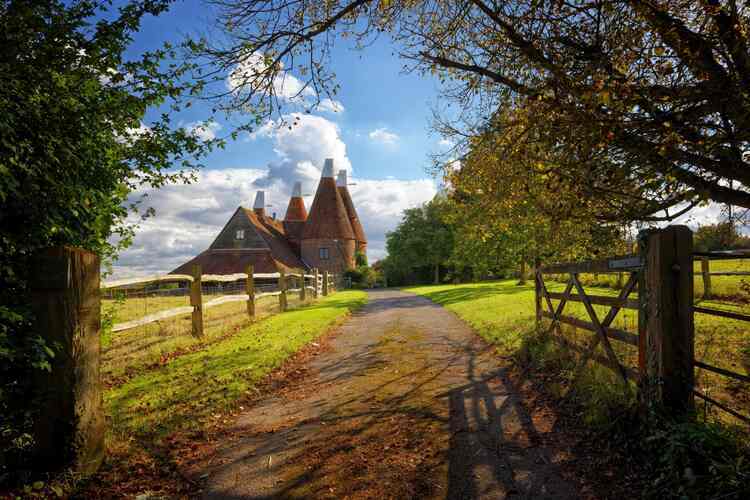
Oast Houses or Hop Kiln Farmhouses are among the most distinctive properties in Kent, Sussex, Surrey and Hampshire. Their traditional roundels and cowls make them attractive homes, but their former agricultural use, unusual layout and construction can make a mortgage application more involved than it would be for a conventional house.
A Hop Kiln (also known as an oast house) is a traditional agricultural building designed to dry green hops for the brewing industry.
It is certainly possible to get a mortgage on an oast house. A specialist mortgage to buy an oast house is not automatically required, particularly where the building has been properly converted into a single, habitable residence and is readily saleable.
Oast houses are increasingly becoming luxury homes with land and sometimes stables, a swimming pool, tennis court and outbuildings. Mortgage lenders will assess the property as well as the borrowers. Its decision may depend heavily on the valuer's comments.
For a mortgage of this kind, Trinity Financial would normally discuss the property with suitable lenders before making a full application. This can reduce the risk of paying valuation fees or recording an unnecessary declined application.
Would a property with ten acres of paddock land and stables be acceptable to a mainstream mortgage lender?
Potentially, yes. Ten acres is within the published or discretionary limits of several residential lenders, although there is no single market-wide acreage rule.
The lender will want to know:
-
Whether any land adjoins the house and sits within the same title;
-
Whether any of the land or outbuildings used produce an income;
-
Whether there is any agricultural occupancy restriction, overage provision or separate right of access;
-
Whether the property resembles a private residence or a farm, commercial livery yard or smallholding;
-
The size, number and condition of the stables and other buildings; and
-
How much of the overall value is attributable to the main house.
Five acres, for example, used privately may be acceptable to a mainstream bank or building society. Rented stables or let-out buildings make the position more complicated because the property is no longer being used exclusively for the owners' private residential enjoyment.
Current lenders' approaches to unusual properties like oast houses vary considerably. Nationwide's criteria, for example, state that the applicant must use the entire property or land for their own residential purposes. Skipton Building Society may consider up to ten acres, but requires residential use only and modest outbuildings. By contrast, Barclays says mixed-use cases, including commercial use of adjoining land or buildings such as stables, can be assessed individually very much on a case-by-case basis.
These policies can change and acceptance always remains subject to underwriting and valuation.
Do rented stables or let-out buildings create a problem for a residential mortgage?
They can do, but the arrangement does not necessarily rule out residential borrowing.
The lender will need to understand exactly what is being rented. There is a significant difference between a neighbour paying a modest amount to use one stable and a professionally operated livery business with multiple customers, employees, signage, deliveries and regular traffic.
The more substantial and permanent the commercial activity, the more likely the case is to fall outside standard residential policy. A lender will also consider whether the arrangement could make it difficult to obtain vacant possession or sell the entire property following repossession.
Before approaching lenders, it would be sensible to establish:
-
How many stables are let and to whom;
-
The rent received and length of the arrangement;
-
Whether the occupier has exclusive possession of any building or land;
-
Whether the agreement is a tenancy, lease, licence or informal arrangement;
-
What notice is required to end it;
-
Whether the occupier has access rights over the driveway or other parts of the property;
-
Whether any business rates, planning permissions or insurance arrangements apply; and
-
Whether the owners provide services that could amount to an active livery business.
The borrower's conveyancer should advise on the legal nature of the arrangement. The mortgage lender may require the agreement to be amended, postponed to its charge or ended before completion.
Does listed status make an oast house harder to mortgage?
Listed status does not prevent a mortgage, but it can narrow lender choice and lead to closer inspection.
Historic England explains that listing covers the whole building and that consent may be needed for work affecting its special interest, including some internal alterations and window replacements. Unauthorised alterations can therefore be an important conveyancing and valuation issue.
The lender and valuer may examine:
-
Whether the oast conversion had the necessary planning, listed-building and building-regulation approvals;
-
Whether later extensions or alterations were authorised;
-
Structural movement, damp, timber decay and the condition of the roundels, kilns, cowls and roof;
-
The cost and availability of suitable listed-building insurance;
-
Whether specialist materials and conservation methods would make repairs more expensive; and
-
Whether the property remains readily marketable to future buyers.
A full building survey from a surveyor experienced with listed and converted rural properties is usually worth considering. The mortgage valuation is for the lender's benefit and is not a detailed condition survey for the buyer.
Would a property with swimming pool, tennis court and outbuildings affect the mortgage?
These features are not normally unacceptable by themselves. They can, however, influence marketability, maintenance costs and the valuer's assessment of the property's worth.
A valuer may not add the full construction cost of a swimming pool, tennis court or outbuilding to the mortgage valuation. The facilities may appeal to a smaller pool of buyers and could be treated as ancillary to the main house rather than as separately valuable assets.
The lender may also want confirmation that:
-
The facilities are for private use and are not hired commercially;
-
The buildings have the necessary planning and listed-building consents;
-
No outbuilding is separately occupied without approval;
-
The pool and other facilities are properly insured and in reasonable condition; and
-
The property's running costs have been allowed for in the affordability assessment.
Will the lender value the house, land and outbuildings as a whole?
The lender will normally take a legal charge over the whole title offered as security. That does not mean every element will receive full value in the lender's valuation.
Depending on its policy, a lender may:
-
Value the entire property as one residential holding;
-
Attribute most of the value to the oast house and its immediate garden;
-
Give limited or no additional value to excess acreage, stables or leisure facilities;
-
Exclude the value of any commercially occupied element from its loan-to-value calculation; or
-
Reduce the valuation because the property has a narrower resale market.
For example, Virgin Money's current criteria state that it has no maximum acreage but will not include land over two acres for valuation purposes, while its charge must still cover the whole property and all the land within the title.
This distinction matters. If the purchase price reflects the full value of five acres, stables and leisure facilities but the lender adopts a more restricted mortgage valuation, the effective loan-to-value may rise and the buyer may need a larger deposit.
Mainstream lender, private bank or specialist lender?
For this type of case, Trinity Financial would normally start with a mainstream residential lender that offers manual underwriting and is willing to consider a mixed-use property. The property details and stable agreement should be referred to the lender or its valuer before a full application wherever possible.
A larger loan does not automatically make a private bank necessary. The most suitable route will depend on the mortgage amount, property value and loan-to-value, the applicants' income and assets, and the nature of the stable rental.
| Lending route | When it may work | Main consideration |
|---|---|---|
| Mainstream residential lender | The oast is a marketable home, the commercial element is small and the loan-to-value is acceptable | Criteria can be rigid and the valuer's opinion is crucial |
| Private bank | The clients have strong income, investments or wider assets and need a more bespoke view of the estate | Pricing, minimum loan or asset requirements and banking relationships vary |
| Specialist or mixed-use lender | The stable rental is material, occupation rights are complex or mainstream lenders decline the security | Rates and fees may be higher than standard residential products |
The best initial approach is not to assume that specialist finance is required. It is to package the case properly and test the most competitive credible residential options first.
Are there any lenders to avoid for this property?
There should not be a permanent blacklist based only on the lender's name because policies change and an individual valuer can materially affect the outcome. However, applications should not be sent speculatively to lenders whose published rules conflict with the facts.
For as long as the stables remain rented:
-
A lender requiring the whole property and land to be used solely by the applicants is unlikely to fit;
-
A lender accepting acreage only where it is entirely residential may be unsuitable;
-
A lender that excludes land beyond a stated acreage from its valuation could produce an unexpectedly low valuation; and
-
An automated lender with no route for a property referral may create unnecessary valuation costs and delays.
Nationwide's published own-use requirement makes it an unlikely starting point while third parties rent the stables. Skipton's residential-use-only exception may present a similar issue. Virgin Money's two-acre valuation approach may be less helpful if a significant part of the agreed price is attributable to the remaining land.
This does not mean those lenders will always be unsuitable for every oast house. The recommendation could change if the rental arrangement ends, the title is restructured with legal advice or the valuer attributes sufficient value to the main residence and immediate grounds.
How could the mortgage be structured?
An exact recommendation cannot be made from the property description alone. Trinity Financial would also need the purchase price or current value, deposit or equity, applicants' income, ages, preferred mortgage term, repayment strategy and future plans.
Once an acceptable lender has been identified, the following structures could be compared:
| Option | Potential advantage | Points to check |
|---|---|---|
| Two-year fixed rate | Payment certainty with an earlier opportunity to review the mortgage | Product fee, early repayment charges and remortgage costs after two years |
| Five-year fixed rate | Longer payment certainty and fewer near-term refinancing decisions | Longer early repayment charge period if the property may be sold or the loan reduced |
| Tracker or variable rate | May suit borrowers expecting to make large repayments, particularly if the product has no early repayment charge | Monthly payments can rise as the tracked rate changes |
| Part fixed and part tracker | Can combine some payment certainty with flexibility | Not all lenders allow this; two product end dates can complicate future refinancing |
| Repayment mortgage | Reduces the capital balance over the term | Higher contractual monthly payments than interest-only |
| Part repayment and part interest-only | Can lower required monthly payments while repaying some capital | Requires an acceptable and credible repayment plan for the interest-only element |
Mortgage fees should be assessed by total cost rather than headline rate alone. A percentage-based fee can be expensive on a larger loan, while a slightly higher rate with a modest fixed fee may sometimes cost less overall.
Early repayment charges and overpayment allowances also need careful comparison. Many fixed products permit limited annual overpayments, often calculated as a percentage of the outstanding balance, but the rules vary. Some trackers have no early repayment charges and can be useful where the borrowers expect a bonus, asset sale, inheritance or future refinance. Current product illustrations must be checked before an application because rates and features can change at short notice.
Aaron Strutt, Product Director at Trinity Financial, comments:
“It should be possible to arrange a mortgage on a listed oast house through a standard lender offering the most compeitively priced rates. Our first step would usually be to approach the biggest lenders that manually assess unusual and mixed-use properties. If the commercial element is too significant, or the borrowers need more flexibility around income and assets, a private bank or specialist lender may be the better solution.
“The lender's valuation is critical. Even when the whole title is taken as security, the bank may base its lending mainly on the oast house and immediate gardens rather than giving full value to every acre, or any stables or leisure facilities.”
Call Trinity Financial on 020 7016 0790 to secure a mortgage to buy an Oast House larger mortgage loan, book a consultation, or complete our mortgage questionnaire.
The information contained within was correct at the time of publication but is subject to change. It is for general information purposes and is not advice.
Your mortgage is secured on your property. Your property may be repossessed if you do not keep up repayments on your mortgage
Not automatically. Some converted oast houses use conventional brick, tile and timber construction, but the valuer will consider the building's precise materials, age, conversion quality and condition. A lender may still treat its design and former use as unusual.
Yes. Many lenders consider Grade II listed homes, subject to valuation, condition, insurance and satisfactory evidence that alterations had the necessary consent. Grade I and Grade II* properties may require a more specialist approach.
Only with the lender's agreement and subject to planning, legal and insurance requirements. Existing or proposed rental arrangements should be disclosed before the mortgage completes.

Get started today
Speak to one of our mortgage experts. Book an appointment to come and see us or request one of our experts to call you.