£1 Million Mortgage UK: Rates, Repayments, Criteria and Income Needed
Tags: Remortgages, Residential mortgages
Quick Summary
A £1 million mortgage is available from high-street banks, building societies, specialist lenders and private banks. Monthly repayments depend on the interest rate, mortgage term and whether the loan is arranged on a repayment or interest-only basis. At 4.5%, a £1 million interest-only mortgage would cost around £3,750 per month, compared with approximately £5,558 on a 25-year repayment term. Applicants may need a combined income of around £222,222 at 4.5 times income, £200,000 at five times income or £166,667 at six times income. Selected lenders may also accept bonuses, commission, RSUs, carried interest, dividends and foreign-currency earnings. Trinity Financial’s large-loan mortgage brokers compare high-street and private banks, including lenders offering interest-only mortgages, flexible affordability and borrowing of up to 90% loan-to-value for suitable applicants.

£1 Million Mortgage UK: Rates, Repayments, Criteria and Income Needed
£1 million mortgages are certainly not limited to private banking clients, especially now high-street banks, building societies, specialist lenders and private banks all compete for large mortgage business, although their rates, affordability calculations and lending criteria vary significantly.
A £1 million mortgage could cost between approximately £3,333 and £4,583 per month on an interest-only basis, depending on whether the mortgage rate is priced around 4% or 5.5%. On a capital repayment mortgage over 25 years, the monthly payment could range from approximately £5,278 to £6,141.
The amount you can borrow will depend on your income, deposit, financial commitments, credit profile, property and proposed repayment method. Some lenders may offer between 4.5 and six times income, while a small number can consider higher multiples for suitable high earners and professionals - possibly up to 6.5 times single or joint income.
Trinity Financial’s specialist large-loan brokers arrange £1 million-plus mortgages for high earners, business owners, company directors, entrepreneurs, private equity professionals, investment bankers, lawyers and barristers, doctors, landlords and international clients.
£1 million mortgages at a glance
| Mortgage consideration | Typical position |
|---|---|
| Mortgage amount | £1,000,000 |
| Interest-only payment at 4.5% | £3,750 per month |
| 25-year repayment mortgage at 4.5% | Approximately £5,558 per month |
| Income required at 4.5 times income | Approximately £222,222 |
| Income required at five times income | £200,000 |
| Income required at 5.5 times income | Approximately £181,818 |
| Income required at six times income | Approximately £166,667 |
| Property value at 75% LTV | Approximately £1,333,333 |
| Deposit required at 75% LTV | Approximately £333,333 |
| Property value at 80% LTV | £1,250,000 |
| Deposit required at 80% LTV | £250,000 |
| Property value at 85% LTV | Approximately £1,176,471 |
| Deposit required at 85% LTV | Approximately £176,471 |
These figures are illustrations rather than lending guarantees. Each bank or building society applies its own affordability and eligibility rules.
How much does a £1 million mortgage cost per month?
The monthly cost of a £1 million mortgage primarily depends on:
-
The mortgage interest rate
-
Whether the mortgage is repayment or interest-only
-
The length of the mortgage term
-
Any product or arrangement fees added to the loan
-
Whether the rate is fixed, variable, discounted or linked to the Bank of England base rate
£1 million mortgage repayments by interest rate
The following figures are approximate monthly payments. They assume the rate remains unchanged for the full term and exclude lender fees, legal costs and insurance.
| Mortgage rate | Interest-only | Repayment over 20 years | Repayment over 25 years | Repayment over 30 years | Repayment over 35 years |
|---|---|---|---|---|---|
| 4.00% | £3,333 | £6,060 | £5,278 | £4,774 | £4,428 |
| 4.25% | £3,542 | £6,192 | £5,417 | £4,919 | £4,579 |
| 4.50% | £3,750 | £6,326 | £5,558 | £5,067 | £4,733 |
| 4.75% | £3,958 | £6,462 | £5,701 | £5,216 | £4,889 |
| 5.00% | £4,167 | £6,600 | £5,846 | £5,368 | £5,047 |
| 5.25% | £4,375 | £6,738 | £5,992 | £5,522 | £5,207 |
| 5.50% | £4,583 | £6,879 | £6,141 | £5,678 | £5,370 |
Source: Trinity Financial mortgage repayment calculations, July 2026. Figures rounded to the nearest pound.
How much income do you need for a £1 million mortgage?
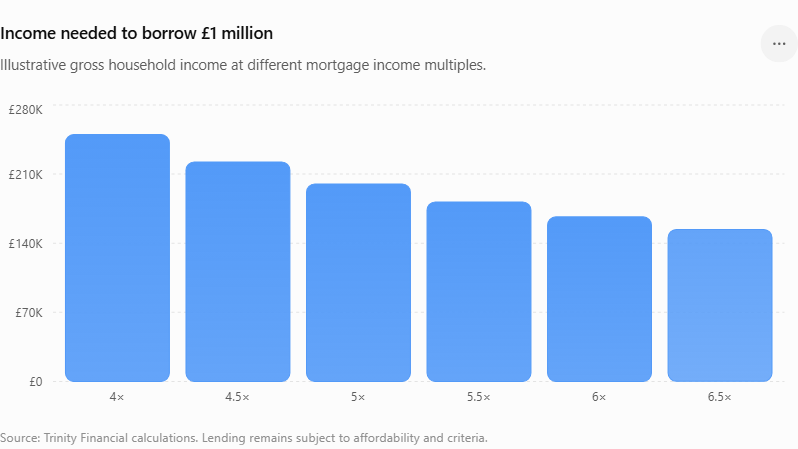
A household would need a combined annual income of approximately £222,222 if a lender offers 4.5 times income. The required income falls to £200,000 at five times income and approximately £166,667 at six times income.
| Lender income multiple | Approximate income needed for a £1 million mortgage |
|---|---|
| 4 times income | £250,000 |
| 4.5 times income | £222,222 |
| 5 times income | £200,000 |
| 5.5 times income | £181,818 |
| 6 times income | £166,667 |
| 6.5 times income | £153,846 |
Source: Trinity Financial calculations, July 2026.
Lenders do not simply multiply an applicant’s salary by a set figure. They normally complete an affordability assessment that considers income alongside mortgage payments, loans, credit cards, childcare costs, school fees, maintenance payments and other regular expenditure.
The Financial Conduct Authority requires regulated mortgage lenders to assess whether a customer can afford the mortgage. A lender may also impose its own maximum loan-to-income multiple.
Trinity Financial brokers regularly arrange 4.5 times income larger mortgages, and they remain a common starting point, while five, 5.5 and six times income may be available through selected lenders. A limited number of options can reach 6.5 times income for suitable applicants.
Can high earners borrow six times their income?
Some banks and building societies offer enhanced income multiples to higher earners, professionals and applicants with strong future earning potential.
More generous affordability may be available to:
-
Applicants earning more than £75,000 or £100,000
-
Doctors, dentists, barristers and solicitors
-
Accountants and other qualified professionals
-
Investment bankers and private equity professionals
-
Senior executives and company directors
-
First-time buyers using selected lender schemes
-
Borrowers with low debts and limited financial commitments
-
Clients taking a longer mortgage term
-
Existing premier or private banking customers
A higher salary does not automatically produce a larger mortgage. Some £200,000 earners have substantial school fees, loans, investment property costs or other commitments that reduce affordability. Conversely, a borrower with a lower basic salary may have a large and consistent bonus, partnership profit, commission or share-based income that certain lenders are willing to include.
Do lenders accept bonuses, commissions, and RSUs?
Income assessment is often the most important part of a £1 million mortgage application.
Some lenders may use:
-
Basic salary
-
Annual and quarterly bonuses
-
Commission
-
Overtime
-
Restricted stock units and vested shares
-
Carried interest
-
Partnership drawings and profit share
-
Dividends
-
Retained company profit
-
Foreign-currency income
-
Investment income
-
Trust distributions
-
Pension income
-
Rental income
Lenders calculate variable income in different ways. One bank might average the latest two years’ bonuses, another may use the lowest figure, and another may use the most recent award where it is demonstrably sustainable. Some lenders may also be able to work off a new contract if you have changed jobs and have a pay rise.
For borrowers receiving RSUs, carried interest or substantial deferred bonuses, selecting a lender that understands the income structure can make a considerable difference to the maximum loan.
What deposit is needed for a £1 million mortgage?
The required deposit depends on the mortgage amount and maximum loan-to-value ratio.
A £1 million loan at 80% LTV would finance a property costing £1.25 million and require a £250,000 deposit. At 75% LTV, the purchase price would be approximately £1.333 million and the deposit approximately £333,333.
| Maximum LTV | Approximate property value | Approximate deposit |
|---|---|---|
| 60% | £1,666,667 | £666,667 |
| 65% | £1,538,462 | £538,462 |
| 70% | £1,428,571 | £428,571 |
| 75% | £1,333,333 | £333,333 |
| 80% | £1,250,000 | £250,000 |
| 85% | £1,176,471 | £176,471 |
| 90% | £1,111,111 | £111,111 |
Source: Trinity Financial calculations, July 2026.
Larger deposits generally provide access to more lenders and potentially cheaper mortgage rates. However, borrowers should consider whether using all their available cash for the deposit is sensible.
Some clients prefer to retain money for renovations, investments, school fees, tax liabilities or business purposes. A slightly larger mortgage may therefore be appropriate even where the borrower could provide a bigger deposit.
Can you get a £1 million mortgage with a 10% or 15% deposit?
A small number of lenders can consider £1 million mortgages at 85% or even 90% LTV, although maximum loan restrictions and property criteria often apply.
Higher-LTV large loans are most likely to be available where the applicant has a strong and sustainable income and a good credit record, low levels of unsecured debt and a conventional, readily saleable property. Also, a suitable mortgage term, a substantial surplus after monthly commitments and a stable employment or professional history.
The rate available at 85% or 90% LTV may be higher than at 60% or 75% LTV. There may also be fewer lenders willing to provide a £1 million advance at those levels.
Should you choose repayment or interest-only?
A repayment mortgage gradually reduces the outstanding debt through monthly payments containing both capital and interest. Provided every payment is made, the mortgage should be repaid at the end of the term.
An interest-only mortgage requires the borrower to pay the monthly interest, while the original £1 million capital balance remains outstanding. The borrower needs a credible strategy for repaying it.
Potential repayment strategies include:
-
Selling the mortgaged property
-
Selling another property
-
Investments
-
Pensions, where acceptable
-
Maturing investment portfolios
-
Future bonuses or share awards
-
The sale of a business
-
A trust distribution
-
Downsizing to a less expensive home
Interest-only can significantly lower the monthly contractual payment. At 4.5%, the monthly interest on £1 million is £3,750. The equivalent repayment mortgage over 25 years is approximately £5,558.
However, interest-only is not automatically cheaper over the entire mortgage term because the capital does not reduce. It is most suitable where the borrower has a robust and realistic repayment strategy.
Some lenders also offer part-repayment and part-interest-only mortgages. For example, £500,000 could be placed on repayment and £500,000 on interest-only.
Does a £1 million mortgage require a private bank?
Many clients assume a £1 million mortgage must be arranged through a private bank. That is not necessarily the case.
High-street banks and building societies may provide particularly competitive rates where the client has straightforward income, a good deposit and a conventional property.
A private or specialist bank may be more suitable where the client has:
-
Complex or irregular earnings
-
Substantial bonus income
-
Carried interest or RSUs
-
Significant assets but relatively limited taxable income
-
Income paid in a foreign currency
-
An international residency profile
-
A requirement for a large interest-only mortgage
-
A trust or complex ownership structure
-
An unusual or high-value property
-
A need for borrowing above standard lender limits
Private banks may assess the client’s wider financial position rather than relying entirely on a conventional salary multiple. Some require assets under management, while others will provide a standalone mortgage without requiring the borrower to transfer investments.
Private banking is not always cheaper. In many cases, a high-street lender can provide a lower rate if the borrower meets its standard criteria.
Does borrowing £1 million make you a high-net-worth mortgage customer?
A £1 million loan does not, by itself, mean that a customer meets the Financial Conduct Authority (FCA) definition of a high-net-worth mortgage customer.
The FCA definition generally requires annual net income of at least £300,000 or net assets of at least £3 million, or a qualifying guarantee from someone meeting the definition.
This distinction matters because certain lenders can apply specialist high-net-worth underwriting approaches to qualifying customers. However, there is no universal rule stating that every mortgage becomes a high-net-worth mortgage simply because the loan reaches £1 million.
Many £1 million applications are still arranged under standard regulated mortgage affordability rules.
What properties can be purchased with a £1 million mortgage?
Large mortgage lenders finance a wide range of properties, including:
-
Prime London flats and houses
-
Family homes in London and the South East
-
Country houses
-
Listed buildings
-
New-build apartments
-
Properties with annexes
-
Homes with substantial acreage
-
Gated properties
-
Penthouses
-
Converted buildings
-
Properties above commercial premises
-
Second homes
-
Renovation projects
The property will normally be professionally valued for the lender. The valuer will comment on its condition, construction, location, marketability and suitability as mortgage security.
Some lenders restrict the percentage they will lend against very expensive flats, new-build properties, unusual construction, short leases or homes with extensive land.
Where are £1 million-plus properties most common?
The average UK house price was approximately £270,000 in April 2026, although property values vary considerably by region.
London continues to have the highest regional house-price-to-earnings ratio. The average London home sold for approximately 10.6 times average earnings during 2025, according to the Office for National Statistics.
In Richmond upon Thames, the average price of a home bought with a mortgage was around £800,000 in April 2026. In Elmbridge, the average property price was approximately £741,000 during the same period. These averages mean many larger family homes in these areas cost well over £1 million.
Million-pound mortgages are particularly common in:
-
Central and Greater London
-
Surrey
-
Hertfordshire
-
Berkshire
-
Buckinghamshire
-
Oxfordshire
-
Cambridgeshire
-
Prime coastal locations
-
Affluent commuter towns
-
Selected country-house markets
How much stamp duty is payable on a property with a £1 million mortgage?
Stamp Duty Land Tax is based on the property price rather than the mortgage amount.
In England and Northern Ireland, the standard residential SDLT threshold is £125,000. Different rates may apply to additional properties, company purchases and buyers classed as non-UK residents for SDLT purposes.
Someone borrowing £1 million at 80% LTV would be purchasing a £1.25 million property. Based on standard residential rates in force in July 2026, the SDLT would be:
| Portion of purchase price | Rate | Tax |
|---|---|---|
| First £125,000 | 0% | £0 |
| £125,001 to £250,000 | 2% | £2,500 |
| £250,001 to £925,000 | 5% | £33,750 |
| £925,001 to £1.25 million | 10% | £32,500 |
| Total | £68,750 |
Additional-property and non-resident surcharges may increase the bill. Buyers should obtain specialist tax and legal advice before proceeding.
Which lenders offer £1 million mortgages?
The large mortgage market includes:
-
Major high-street banks
-
Building societies
-
Banks with premier customer propositions
-
Specialist large-loan lenders
-
Private banks
-
International banks
-
Specialist buy-to-let lenders
The most suitable lender depends on the applicant rather than simply which institution is advertising the lowest rate.
Trinity Financial compares high-street lenders, building societies and private banks. The firm’s brokers consistently arrange mortgages between £1 million and £5 million for clients buying and refinancing high-value property.
The firm also has access to specialist large-loan teams and private banking contacts.
What documents are needed?
The application normally requires:
Employed applicants
-
Latest payslips
-
P60
-
Bank statements
-
Evidence of bonuses and commission
-
Employment contract, where appropriate
-
Evidence of RSUs or share awards
-
Identification and address verification
Company directors and self-employed applicants
-
Tax calculations and tax-year overviews
-
Two or three years’ accounts
-
Business bank statements
-
Personal bank statements
-
Accountant’s reference
-
Management accounts
-
Details of retained profit and dividends
High-net-worth and international applicants
-
Asset and liability statement
-
Investment portfolio statements
-
Evidence of overseas income
-
Foreign tax returns
-
Trust documentation
-
Proof of deposit and source of wealth
-
Details of other properties
-
Evidence of residency and visa status
Large-loan underwriters may ask more detailed questions than standard mortgage teams. Providing a clear summary of the client’s income, assets, deposit and repayment strategy at the outset can help avoid delays.
How long does it take to obtain a £1 million mortgage?
Straightforward applications can sometimes receive a mortgage offer within days, particularly where the lender has a dedicated large-loan team and the valuation is completed quickly.
More complex applications can take longer where:
-
Bespoke underwriting is required
-
Income is paid from several sources
-
The applicant is self-employed
-
The property is unusual
-
A private bank’s credit committee must approve the loan
-
Overseas assets or income need verification
-
Specialist legal work is required
-
The valuation is complex
Applicants should ideally speak to a broker before making an offer or committing to a completion deadline.
Why use Trinity Financial for a £1 million mortgage?
Trinity Financial has helped arrange more than 21,000 mortgages and specialises in large, complex and high-net-worth borrowing.
Its large-loan brokers can compare:
-
High-street mortgage rates
-
Premier customer mortgages
-
Building society large-loan teams
-
Private banks
-
Specialist interest-only lenders
-
Lenders accepting bonus and commission income
-
RSU and share-income mortgage providers
-
Foreign-currency and international mortgages
-
Mortgages for company directors and business owners
This is important because the lender offering the cheapest advertised rate may not provide the largest loan or accept the applicant’s complete income structure.
Aaron Strutt, product director at Trinity Financial, says: “Our brokers have access to leading high-street banks and building societies that offer attractively priced large mortgages, particularly for applicants with straightforward income and a sizeable deposit. Private banks and specialist lenders become useful where a borrower has complex bonus income, carried interest, RSUs, overseas earnings or needs a more flexible interest-only structure.
“The key is to compare the rate, affordability calculation and underwriting criteria. A slightly more expensive mortgage rate may be worthwhile if the lender includes more of the client’s income or provides the loan structure they need, like a mortgage with no early repayment charges on a pure interest-only mortgage.”
Speak to a £1 million mortgage broker
The mortgage market moves fast — and the right advice can make a significant difference to the rate and deal you secure. Get in touch with our team to discuss your options.
Call Trinity Financial on 020 7016 0790 to secure a £1 million fixed or tracker rate mortgage, book a consultation, or use our appointment calendar
The information contained within was correct at the time of publication but is subject to change. It is for general information purposes and is not advice.
Your mortgage is secured on your property. Your property may be repossessed if you do not keep up repayments on your mortgage

Get started today
Speak to one of our mortgage experts. Book an appointment to come and see us or request one of our experts to call you.