Guest blog from David Campbell at Vision + Design Architects
Quick Summary
London renovation costs have risen significantly, making careful planning essential. David Campbell of Vision + Design Architects explains why buyers and homeowners should check likely building costs, planning restrictions, property condition and potential delays before starting work.
Speaking to an architect and mortgage broker early can help confirm whether a project is affordable, suitable for mortgage finance and realistic within the available budget.

London building costs are around a third higher than before Covid: how buyers and homeowners can bring certainty back to a project
David Campbell, Vision and Design, RIBA Chartered Architects, London
Many of the enquiries we have taken in the last few years from property buyers or owners looking to understand their options on extending or renovation have followed a similar pattern. Someone needs to know what the work will really involve and potentially cost before they commit. Increasingly they need that answer in days rather than weeks. For a buyer the deadline is an exchange or a competing bid. For an owner it is a remortgage or a product transfer with a rate that will not still be there next month.
The cost figure people arrive with is usually out of date, and the complexities underestimated. Cost’s come from a friend's project finished three or four years ago, or from a rate found online. The real number is higher, and the reasons are structural rather than temporary.
That is why we give an initial view on a property at no cost. It is far quicker and cheaper to test a scheme on paper than to discover its constraints after exchange.
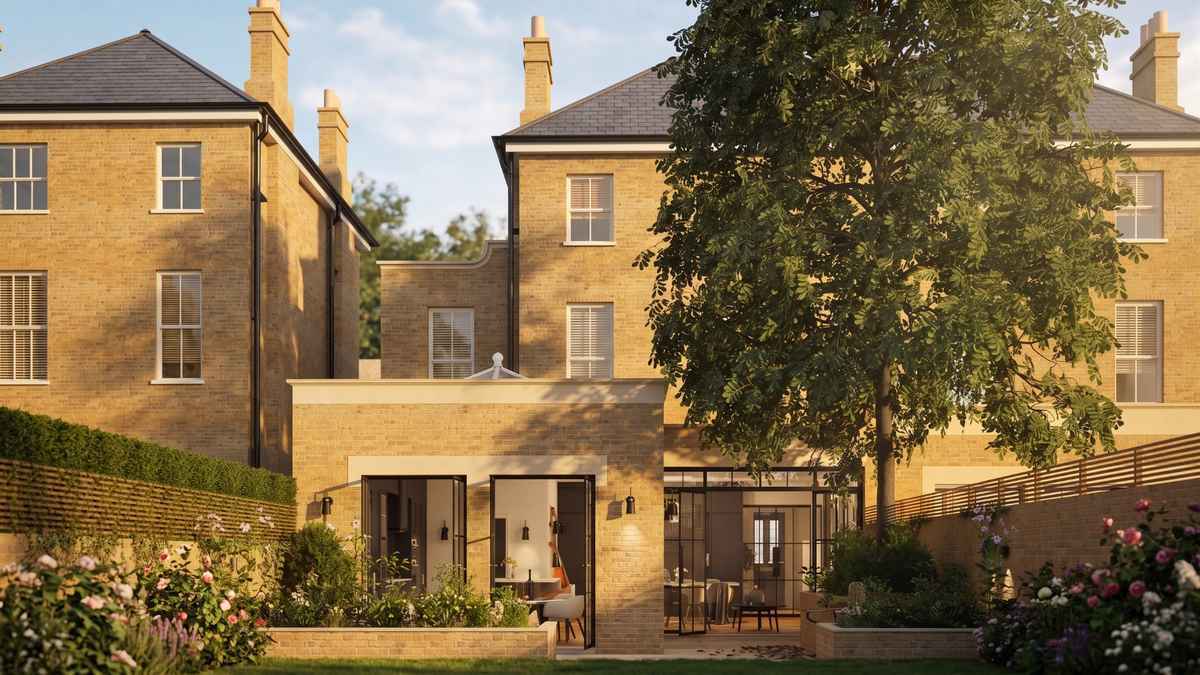
Picture above: A feasibility and concept design study by Vision + Design Architects for the extensive remodel and extension of a period villa in Richmond upon Thames, within a designated Conservation Area.
How much have building costs risen since Covid?
Office for National Statistics figures put the construction output price index for all work at 110.6 in 2020 and 151.8 in early 2025, a rise of roughly 37%. Inflation peaked at 26.8% in the year to June 2022, the steepest in four decades. On those figures, work priced at £200,000 in 2019 is closer to £270,000 today for the same specification.
Are prices coming back down?
No. They have settled at a higher level. The BCIS General Building Cost Index rose 3.8% in the year to Q2 2026, and BCIS forecasts a further 13.1% increase over the five years to Q2 2031. For London, Turner and Townsend alinea forecast tender price inflation of 3.5% for both 2026 and 2027. Waiting for a correction is not a strategy.
What is driving the increase now?
Labour rather than materials. Material prices have flattened, with the Department for Business and Trade index for all work up 3.0% in the year to November 2025. Labour has not. The BCIS Labour Cost Index rose 7.1% in the year to Q2 2025, and CITB estimates the industry needs 47,860 additional workers a year to 2029 to meet demand. In London the skilled trades market is tighter still.
Why do so many projects overrun?
Research by Hiscox found 40% of renovators overspent, by an average of 20%, and that 35% ran late by an average of three months. Those figures date from 2018 and the cash overruns will be larger now. In our experience overruns are rarely caused by price rises during the build. They are caused by scope that was never resolved before work started, and by what is found in older housing stock once it is opened up.
What if the builder fails?
Construction was the worst UK sector for insolvency for the fourth consecutive year in 2025, with 3,931 firms failing. That is 17% of all UK insolvencies from a sector making up around 14% of registered businesses. Specialist subcontractors accounted for roughly half of monthly failures. Paying large sums in advance is how homeowners usually get caught.
Is planning a formality?
Not in London. Across England around 90% of householder applications are granted, but London boroughs refuse roughly 30%. Conservation areas, Article 4 directions and listed status also remove permitted development rights that homeowners elsewhere rely on.
Does the work add the value people expect?
Often, but not always. Nationwide research indicates a loft conversion or extension adding a double bedroom and bathroom can add up to 24% to the value of a three bedroom, one bathroom house, and that a 10% increase in floor area adds around 5%. In higher value London postcodes, spend can exceed value added, so the case needs testing against local comparables rather than national averages.
How does this affect the mortgage?
The condition of a property affects what a lender will advance against it. A house without a working kitchen or bathroom is often treated as uninhabitable, and where a valuer flags essential works, part of the loan can be held back until they are done. Knowing the scope and cost of the work early lets your broker match the right product to it, whether that is a renovation facility releasing funds in stages or simply borrowing enough at the outset.
What to cover alongside the finance
Planning risk. Whether consent is needed, how the borough has treated similar schemes, and whether permitted development rights are available or removed.
Physical constraints. How much you can actually build, and where. How far into the garden you can go, how much of the side return is usable, whether the roof can be raised, and what the boundaries and the neighbouring houses allow
Regulatory scope. Which parts of the Building Regulations are triggered, including whether Part L and Part F upgrades apply to the existing fabric.
Party wall. Which neighbours are affected and what it costs. Checkatrade's 2026 guidance puts a typical award at around £1,000, rising to about £2,025 for extensions and £3,375 for basements.
Indicative Budget. Priced against a construction index rather than general inflation, with 10 to 15% contingency on a straightforward extension and 15 to 20% on whole house refurbishment, basements and pre-1919 or listed property.
Procurement route. How the work is bought, and who carries the risk. A fully designed scheme put out to competitive tender gives you a firm price and comparable bids before you commit, while bringing a builder in earlier buys speed but fixes the number later. The right route depends on how settled the scope is and how much risk you want to hold.
Programme. Consent, party wall, procurement and construction sequenced against the drawdown rather than assumed to run in parallel.
If you are weighing up a purchase or a project, we will look at it with you at no cost. That might be an appraisal of what a property can take, a note on planning, physical and regulatory constraints, to test whether it is worth doing at all. The intention is to bring the certainty forward, to the point where it is still cheap to change your mind.
Contact David Campbell
Call: +44 (0)7931910243
Visit: www.visionanddesign.co.uk
Email: david.campbell@visionanddesign.co.uk
Office: 55 Whitfield St, London, W1T 4AH
Any links to third-party websites are provided for information and convenience purposes only. We are not responsible for the content or availability of external sites
Sources:
- ONS, Construction output in Great Britain, December 2025.
- Tokio Marine HCC, UK Construction Sector Report, December 2025 (ONS index 110.6 to 151.8; 26.8% peak).
- BCIS, Construction Industry Forecast, June 2026.
- Turner and Townsend alinea.
- Department for Business and Trade, Construction building materials commentary, December 2025.
- CITB, Construction Workforce Outlook 2025 to 2029.
- Hiscox, Renovations and Extensions Report, 2018.
- Construction News, Construction is worst sector for insolvencies four years running, February 2026.
- MHCLG, Planning applications in England, January to March 2026.
- Nationwide House Price Index research, October 2025.
- Checkatrade, Party wall surveyor cost guide, 2026.

Get started today
Speak to one of our mortgage experts. Book an appointment to come and see us or request one of our experts to call you.